
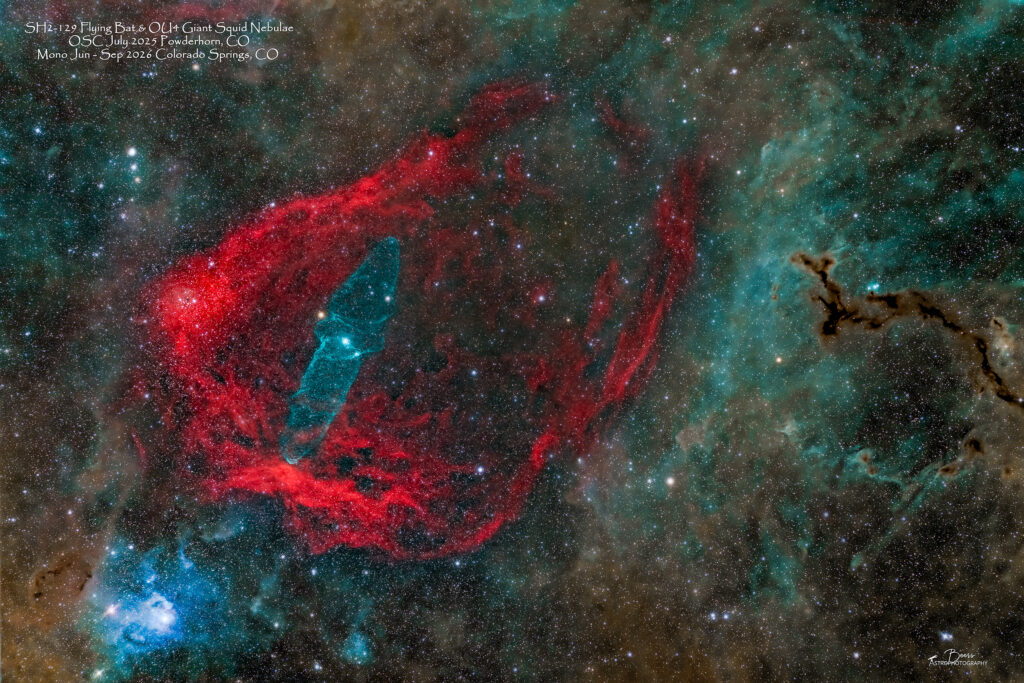
The summer project of collecting data on my “OCD” target continues…or maybe concludes?? At this point, it seems less a matter of collecting more data and more a matter of refining my mono processing skills. But when Thursday night (10 Sep—the New Moon) was forecast to be completely clear in Colorado Springs (albeit a bit windy to start the night), I couldn’t resist one more “data fix” on SH2-129. This time, I focused primarily on Ha, with a little OIII thrown in at the end of the night for good measure, giving me some fresh data for the processing experiments I mentioned after working through the 4 September data.
Until I can spend some dedicated time under truly dark skies, this may be my “final” version of the SH2-129 Flying Bat & Ou4 Giant Squid Nebulae. Although, as with “never say never,” you never really say “final” when it comes to astrophotography processing! For now, though, it’s time to move on to some of those Fall and Winter nebulae!
Fun facts
SH2-129, sometimes referred to as the “Flying Bat” nebula, is a relatively faint emission nebula in Cepheus, a neighbor of the larger and more often imaged IC 1396 Elephant Trunk. This region is characterized by Ha emission as well as a small, mixed emission and reflection nebula (vdB 140). What is most remarkable about this region is a recent discovery, made in 2011 by Nicolas Outters, called the “Squid Nebula” due to its shape, but more officially called Ou4. This region is characterized by a very faint OIII emission that has a bipolar shape reminiscent of a planetary nebula, seen as the teal-colored region just to the right of center. Although it was originally thought to perhaps represent a planetary nebula derived from an unknown, dying star, more recent evidence suggests that Ou4 is located within SH2-129 itself and is a bipolar outflow emitting in the OIII spectrum, moving at the same rate as SH2-129, and possibly emanating from a triple star system located in the center of Ou4 (HR8119, visible above as the bright star in the center of the Squid). Though apparently completely surrounded by the reddish hydrogen emission region Sh2-129, the true distance and nature of the Squid Nebula have been difficult to determine. Still, a more recent investigation suggests Ou4 really does lie within Sh2-129 some 2,300 light-years away. The truly giant Squid Nebula would physically be nearly 50 light-years across.
Other Catalog Designations: SH2-129 Flying Bat Nebula, Ou4 Giant Squid Nebula
Subtype: HII region
Distance from Earth: 2300 light years
Size: 50 light years
Apparent Size: 2°20’
Constellation: Cepheus
{Target information derived from: http://www.starrywonders.com/sh2-129small.html , https://apod.nasa.gov/apod/ap201007.html , and Stellarium }
So WHY is the image flipped randomly with each successive version?
The astrophotography-processing reason for all that flipping is the way my stacking and registration software—Astro Pixel Processor (APP)—chooses the image it uses as the reference, or “anchor,” for the registration step. Exactly how APP makes that choice, however, has always been a bit of a mystery to me. Does it use the image in the middle of the stack? The one with the most data? Or does it simply draw a number out of a hat? I honestly have no idea!
But I finally decided it was time to look it up. I Googled “proper orientation of SH2-129 deep sky object” and, thanks to Google AI’s summary of information from authoritative sources, we now know the answer!
“In astrophotography, there is no single mandated “proper” orientation for deep-sky objects like Sh2-129 (The Flying Bat Nebula), but standard practices dictate how it is typically framed depending on your goal.
1. Traditional Celestial Orientation
If your goal is scientific accuracy or standard mapping, the universal orientation is to place Celestial North at the top and Celestial East to the left. When framed this way:
- The broad, curved wings of the Flying Bat expand horizontally.
- The faint Ou4 (The Giant Squid Nebula), which lies nested directly inside the center of Sh2-129, sits somewhat diagonally across the field.
2. Aesthetic & Parenidolia Orientation (The “Right Side Up” Framings)
Most astrophotographers choose a dynamic composition based on the common nicknames of the target rather than strict celestial directions. Because this target requires a very wide field of view (spanning nearly 3 degrees), there are two popular creative orientations:
- The Horizontal Flying Bat: Many photographers rotate the camera sensor so that the “wings” of Sh2-129 spread horizontally out across the long edge of a rectangular sensor. This makes the outer hydrogen cloud look like a giant bat soaring sideways.
- The Vertical Giant Squid: Because the Squid Nebula (Ou4) is one of the most challenging, highly sought-after OIII structures to pull out in post-processing, some choose to orient the frame vertically. This places the narrow, bipolar lobes of the blue-green Squid standing straight up and down, right in the heart of the Bat.”
So there you have it: mystery solved—and now I know which way the Flying Bat and Giant Squid are supposed to be flying.
But, we’re not done yet…
We’re going to learn all sorts of things by going down this rabbit hole! If you’re like me, you probably had to look up “pareidolia.” According to the Wikipedia definition, it’s the tendency to perceive a familiar pattern or image where none actually exists. Wikipedia — Pareidolia
“Pareidolia (/ˌpærəˈdoʊliə/) is the tendency for perception to impose a meaningful interpretation on a nebulous stimulus, usually visual, so that one detects an object, pattern, or meaning where there is none. Pareidolia is a specific but common type of apophenia (the tendency to perceive meaningful connections between unrelated things or ideas).
Common examples include perceived images of animals, faces, or objects in cloud formations; seeing faces in inanimate objects; or lunar pareidolia like the Man in the Moon or the Moon rabbit. The concept of pareidolia may extend to include hidden messages in recorded music played in reverse or at higher- or lower-than-normal speeds, and hearing voices (mainly indistinct) or music in random noise, such as that produced by air conditioners or by fans.“
Which is pretty much what I’ve been referring to all along as the astrophotography ink-blot test: What do you see? Do you see a Running Chicken? A Fish on the Platter? …or, in this case, do you see a Flying Bat and a Giant Squid—or something completely different??
Apparently, we’re not just processing astrophotographs here…we’re also learning a little about how our brains make pictures out of the cosmos. 😄
Capture & Processing Notes – 10 September 2026 Update
Capture Notes (10 September 2026)
The bad weather forecast for our dark-skies trip forced us to cancel our September trip to Creede, Colorado. True to form, once Mother Nature had ensured the cancellation, Thursday night—the night of the New Moon—turned out to be completely clear in Colorado Springs. So, naturally, I decided to get one more “data fix” on SH2-129. This session focused primarily on Ha, with a little OIII thrown in at the end of the night for good measure, giving me fresh data for the processing experiments I mentioned after working through the 4 September data.
I started the sequence promptly at astronomical twilight (~20:30 MDT) and had a smooth start-up. I came out at 21:57 on my way to bed, however, and discovered that SGP was in recovery mode—ARGH! Three 5-minute Ha subframes had been captured before the AG camera disconnected; the error reported in PHD2 was an ASCOM driver error. I tried encouraging the auto-recovery to “try now,” but since the underlying problem was the physical cable disconnect, it unsurprisingly got nowhere.
So, I manually ended the sequence, parked the scope, disconnected the equipment electronically, disconnected and reconnected the AG camera cable physically, then reconnected everything and restarted the sequence. Surprisingly, SGP performed an abbreviated start-up: one EAF run, settled the AG, and resumed the sequence. Back in business!
I thought I had set my alarm to get up and watch the meridian flip at 22:47 MDT. Apparently, I had not. I woke up around 23:30 MDT and stared at the clock for a moment, trying to remember when the flip was supposed to happen. I checked my phone and confirmed that, indeed, there was no alarm set. 😳 I got up and looked outside to see that the telescope was on the proper post-transit side of the pier—YEAH! I then went out to verify that the sequence was still running and found it happily collecting frame #20 of the Ha sequence. Woohoo!
The PHD2 Calibration Assistant run at the beginning of the night, combined with turning off automatic calibration throughout the SGP sequence, appears to have solved the issue I’ve had with never being able to depend on an automatic meridian flip. …and a very good thing, too. Sleeping through the meridian flip when the mount wasn’t set to flip automatically could have had a disastrous effect on my equipment!
I slept in a little past my normal weekday wake-up time (04:00) to let the sequence continue until the start of astronomical twilight—the end of the imaging night—at 05:15 MDT. Even with the hour lost to the AG camera disconnect, I ended up with 60 × 5-minute Ha subframes and 7 × 15-minute OIII subframes. I added the new Ha data to the June and July data and the OIII data to the July and September data to create this “final” (for now!) version of the Flying Bat and Giant Squid.
A bit more detail of the 10 September 2026 night’s data collection and this image’s processing is in the Blog post: https://beersastrophotography.com/photography-journals/one-final-look-at-the-flying-bat-giant-squid/
The details of the 4 September 2026 night’s collection is in the Blog post: https://beersastrophotography.com/photography-journals/summer-data-collection-project-september-data-boost/
The details of each night’s collection during July 2026 are in the Blog post: https://beersastrophotography.com/photography-journals/summer-data-collection-project-july-installment/
The details of each night’s collection during June 2026 are in the Blog post: https://beersastrophotography.com/photography-journals/summer-data-collection-project-june-installment/
The details of each night’s collection during May 2026 are in the Blog post: https://beersastrophotography.com/photography-journals/its-back-flying-bat-giant-squid-visible-again/
The details of the data collection from Powderhorn, Colorado (dark skies image with one-shot color camera (OSC)) in July 2025 are in the Blog post: https://beersastrophotography.com/photography-journals/one-night-beast-recon-trip-to-tolvar-flats/
Image Data
This latest version of the image includes the 15 minute OIII subframes captured in July and 4 & 10 Sep (110x15min subframes) and the 5 minute subframes captured in June, July, and on 10 Sep (212x5min subframes) to the RGB data collected with the OSC camera in Powderhorn, CO on 26 July 2025.
Total data used to produce image (OIII: July&Sep 15min subframes only; Ha: Jun,Jul,Sep 5-minute subframes; OSC RGB 5-minute subframes): 2845min, 47:25hrs
July 2025 OSC Data – 26Jul2025: 67x5min = 335min, 5:35hrs
- Separated into R, G, B channels for RGB Combine with mono data
Total Ha & OIII mono data used in image (Jun, Jul, Sep2026): 2710min (45:10 hours)
- OIII: 110x15min = 1650min (27:30hrs)
- Ha: 212x5min = 1060min (17:40hrs)
Processing Summary
Stack & Register:
Learning from the stacking experience with the 4 Sep 2026 image—specifically, that properly revealing the Giant Squid’s extremely faint OIII signal requires 15-minute subframes—I stacked all of the available 15-minute OIII data to create the OIII image for the RGB Combine step. This included the September and July data, totaling 110 × 15-minute subframes (1,650 minutes / 27:30 hours). I then stacked all of the Ha data collected in June, July, and September (212 x 5-minute subframes (1060min / 17:40 hours) to create the Ha image for the RGB Combine step.
Finally, I registered and normalized the Ha and OIII images (both with and without light-pollution removal), along with the separately extracted R, G, and B channels from the OSC image, in preparation for the RGB Combine processing.
Combine & Blend:
For this processing run, and because of the “issues” I had dialing in the correct red for the Flying Bat in the 4 Sep 2026 version, I decided to go back to creating separate combined images for each major element: RGB for the background, HaRGB for the Flying Bat (red), and HOO for the Giant Squid. In APP, I used the RGB Combine tool to create these separate images and then blended them together in Lightroom and Photoshop to create the final image.
The APP RGB Combine algorithms were:
- RGB1: Combined the separated R, G, and B channels from the OSC image to create the background and star field.
- HaRGB1: Combined the separated R, G, and B channels from the OSC image with the mono Ha channel to create the red Flying Bat and background.
- HOO1: Combined the Ha and OIII channels to create the OIII-dominant Giant Squid.
- HOO1-RedFB: When APP generated the initial combination, I actually liked the red in the Flying Bat even better than the red I had created with HaRGB, so I saved this version as HOO1-RedFB.
- HOO1-BlueGS: I then recombined the Ha and OIII channels in the RGB Combine tool, this time focusing on maximizing the blue in the Giant Squid, and saved that version as HOO1-BlueGS.
Finally, I blended the four RGB Combine images together in Lightroom and Photoshop, using a series of clipped layer masks to selectively combine the different elements and produce the final image.final image.
Shooting Location
OSC Data – 26 July 2026: BLM location named Tolvar Flats for its proximity to Tolvar Peak, on a flat mesa “overlooking” Blue Mesa Reservoir. (38° 19’ 2.40” N; 107° 11’ 18.30”W) at 8814.2 feet
Mono Data (used in this image) – 10-12, 16, 18, 20 Jun, 11-14 Jul 2026, and 4, 10 Sep 2026: HCH front patio, Colorado Springs, Colorado
Equipment
All equipment controlled by HP Probook (DSO CTRL1) running Sequence Generator Pro v4.5.0.1642
- Imaging (ASI2400-SC w 0.7x reducer): ZWO ASI2400MC imaging camera on Askar FRA600 108mm f/5.6 Quintuplet Petzval Flat-Field Astrograph (Southern Cross) with Askar f/3.9 Full Frame Reducer for FRA600
- RGB data: ZWO ASI2400MC imaging camera; (Southern Cross) Askar FRA600 108mm f/5.6 Quintuplet Petzval Flat-Field Astrograph with Askar 0.7x Reducer for Askar FRA600 108mm Astrograph
- Mono data: ZWO – ASI6200MM Pro Monochrome imaging camera; ZWO – EFW 7×2″ Filter Wheel with installed filters: Svbony SV227 2” Narrow-Band – SII, Ha, OIII
Optolong LRGB Filter Set (2″) (1=SII, 2=Ha, 3=OIII, 4=Lum, 5=Red, 6=Grn, 7=Blue); (Southern Cross) Askar FRA600 108mm f/5.6 Quintuplet Petzval Flat-Field Astrograph with Askar 0.7x Reducer for Askar FRA600 108mm Astrograph
- Mount: Rainbow Astro RST-135E (controlled by iHubo ASCOM driver)
- Polar alignment: QHYCCD camera (controlled by Polemaster for polar alignment)
- Autoguiding: Orion 60mm Multi-Use Guide Scope with ZWO ASI120MM mini mono camera (controlled by PHD2)
- Auto Focuser: ZWO EAF Electronic Automatic Focuser – Standard (EAF-5V-STD)
Summary & Future Considerations:
This image comprises 47:25 hours of total data, including 5:35 hours of OSC RGB data captured at Powderhorn in July 2025 and 41:50 hours of mono data captured from the HCH front patio. The mono data consists of 212 × 5-minute Ha subframes (1,060 minutes / 17:40 hours) captured in June, July, and September 2026 (10, 11, 12, 16, 18, and 20 Jun; 13 Jul; and 10 Sep), along with 110 × 15-minute OIII subframes (1,650 minutes / 27:30 hours) captured in July and September 2026 (11, 12, and 14 Jul; 4 and 10 Sep).
Processing began with APP stacking of the Ha and OIII data, along with separation of the OSC RGB data into individual R, G, and B channels. Using APP’s RGB Combine tool, I created four separate channel-combination images: RGB for the star field and background, HaRGB for the Flying Bat, and HOO for both the Flying Bat and Giant Squid. I processed each combination separately and then blended them using a series of clipping-mask layers, allowing me to bring out the unique characteristics of each combination. Finally, I recombined the star field with the resulting starless blended image.
Until I can get some dedicated time under truly dark skies, this may be my “final” version of the SH2-129 Flying Bat & Ou4 Giant Squid Nebulae. Although, just as you never say never, you never really say final in astrophotography processing! 😄
For now, though, it’s time to move on other Fall and Winter nebulae!
Previous Images of SH2-129 Flying Bat & OU4 Giant Squid Nebulae
The Summer 2026 Project Continues: May – Early September 2026 version
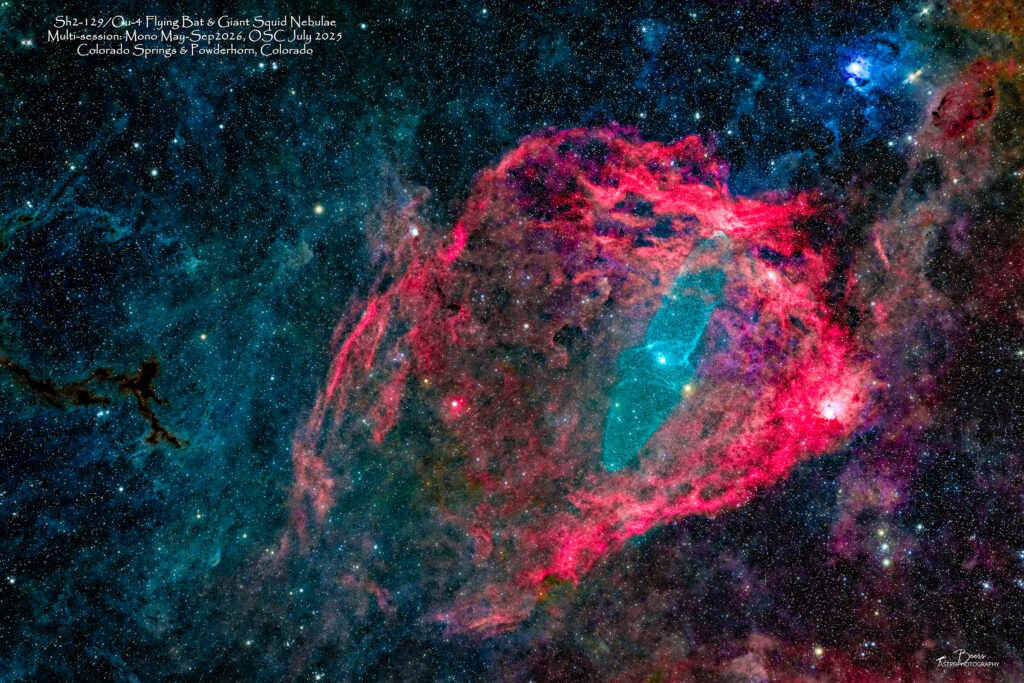
The summer project of collecting data on my “OCD” target—SH2-129 Flying Bat / Ou4 Giant Squid—continues! Once again, Mother Nature apparently got wind of our New Moon dark-skies trip plans and decided to fill the week leading up to the New Moon, and the weekend itself, with storms and clouds. On Friday night, 4 September, our renovation project’s stucco crew had finished their work and, thankfully, removed the scaffolding from in front of the front patio’s sliding glass door. The forecast was calling for a mostly clear night, so I decided to take advantage of both the newly re-accessible patio and the clear skies to get the telescope out and capture more 15-minute OIII subframes of the Flying Bat and Giant Squid. This image adds another approximately seven hours of OIII 15-minute subframes to the data included in the July edition (mono data from May, June, and July, plus OSC data from July 2025). I’d still love to get some dark-skies data into the mix—but for now, we’ll keep those plans under wraps! 😉
Capture & Processing Notes – 4 September 2026 Update
Capture Notes (4 Sep 2026):
A planned dark-skies trip to Creede for the September New Moon was unfortunately abandoned when Mother Nature decided to fill the week—and the weekend—with storms and clouds. Fortunately, Friday night brought a break in the weather, along with the timely removal of the scaffolding from our patio renovation, giving me the opportunity to get the telescope back outside—albeit on the light polluted front patio during a 40% waning moon, but you take clear skies when/where you can get them!
Despite some thin clouds and a few unexpected start-up equipment and software hiccups, the night proved surprisingly productive. I was able to add another almost seven hours of OIII data to my ongoing collection on one of my favorite—and increasingly “OCD”—targets, the SH2-129 Flying Bat Nebula and Ou4 Giant Squid Nebula.
This continues my long-term project combining narrowband and color data collected over multiple nights and months. The dark-skies data I had hoped to add will have to wait for another opportunity (without letting Mother Nature in on the planning!), but the project continues to evolve with each new night under the stars.
A bit more detail of the 4 September 2026 night’s collection is in the Blog post: https://beersastrophotography.com/photography-journals/summer-data-collection-project-september-data-boost/
The details of each night’s collection during July 2026 are in the Blog post: https://beersastrophotography.com/photography-journals/summer-data-collection-project-july-installment/
The details of each night’s collection during June 2026 are in the Blog post: https://beersastrophotography.com/photography-journals/summer-data-collection-project-june-installment/
The details of each night’s collection during May 2026 are in the Blog post: https://beersastrophotography.com/photography-journals/its-back-flying-bat-giant-squid-visible-again/
The details of the data collection from Powderhorn, Colorado (dark skies image with one-shot color camera (OSC)) in July 2025 are in the Blog post: https://beersastrophotography.com/photography-journals/one-night-beast-recon-trip-to-tolvar-flats/
Image Data
This latest version of the image includes the ~7 hours of mono OIII (26x15min subframes) collected on 4 September 2026 to the RGB data collected with the OSC camera in Powderhorn, CO on 26 July 2025; Mono camera Ha data collected during the imaging sessions throughout May, June, and July 2026; and OIII 15-minutes subframes collected in July 2026.
Total data used to produce image (OIII: July&Sep 15min subframes only; Ha: May,Jun,Jul (without 15-16May); OSC RGB data): 2845min, 47:25hrs
July 2025 OSC Data – 26Jul2025: 67x5min = 335min, 5:35hrs. Separated into R, G, B channels for RGB Combine with mono data
Total mono data used in image (May, Jun, Jul, Sep2026): 2510min (41:50 hours)
- OIII: 103x15min; 1545min, 25:45hrs
- Ha: 193x5min; 965min, 16:05hrs
Processing Summary
Stack & Register:
In APP, I evaluated several combinations of the OIII data collected from May through September, including both 10- and 15-minute subframes. The best result came from combining the 103 × 15-minute OIII subframes collected in July and September, without including any of the 10-minute subframe’s data. This version produced the richest detail and contrast in the Ou4 Giant Squid. The selected data were then registered with the existing Ha, SII, and RGB Mono/OSC data, creating a fully aligned set of narrowband and color channels for processing.
Combine & Blend:
I used APP’s RGB Combine tool to create two complementary images. HaRGB combined the RGB OSC data with Ha to produce the dust background, star field, and SH2-129 Flying Bat, while HOO combined Ha and OIII to emphasize the OIII-dominant Giant Squid. The two versions were then selectively blended in Lightroom and Photoshop using clipped layer masks, allowing each component to contribute where it worked best and producing the final image.
Shooting Location & Dates
OSC Data – 26 July 2025: BLM location named Tolvar Flats for its proximity to Tolvar Peak, on a flat mesa “overlooking” Blue Mesa Reservoir. (38° 19’ 2.40” N; 107° 11’ 18.30”W) at 8814.2 feet
Mono Data – 29 & 30 May, 10-12, 16, 18, 20 Jun, 11-14 Jul 2026, and 4 Sep 2026: HCH front patio, Colorado Springs, Colorado
Equipment
All equipment controlled by HP Probook (DSO CTRL1) running Sequence Generator Pro v4.5.0.1642
- Imaging (ASI2400-SC w 0.7x reducer): ZWO ASI2400MC imaging camera on Askar FRA600 108mm f/5.6 Quintuplet Petzval Flat-Field Astrograph (Southern Cross) with Askar f/3.9 Full Frame Reducer for FRA600
- RGB data: ZWO ASI2400MC imaging camera; (Southern Cross) Askar FRA600 108mm f/5.6 Quintuplet Petzval Flat-Field Astrograph with Askar 0.7x Reducer for Askar FRA600 108mm Astrograph
- Mono data: ZWO – ASI6200MM Pro Monochrome imaging camera; ZWO – EFW 7×2″ Filter Wheel with installed filters: Svbony SV227 2” Narrow-Band – SII, Ha, OIII
Optolong LRGB Filter Set (2″) (1=SII, 2=Ha, 3=OIII, 4=Lum, 5=Red, 6=Grn, 7=Blue); (Southern Cross) Askar FRA600 108mm f/5.6 Quintuplet Petzval Flat-Field Astrograph with Askar 0.7x Reducer for Askar FRA600 108mm Astrograph
- Mount: Rainbow Astro RST-135E (controlled by iHubo ASCOM driver)
- Polar alignment: QHYCCD camera (controlled by Polemaster for polar alignment)
- Autoguiding: Orion 60mm Multi-Use Guide Scope with ZWO ASI120MM mini mono camera (controlled by PHD2)
- Auto Focuser: ZWO EAF Electronic Automatic Focuser – Standard (EAF-5V-STD)
The Summer 2026 Project Continues: May-July 2026 version
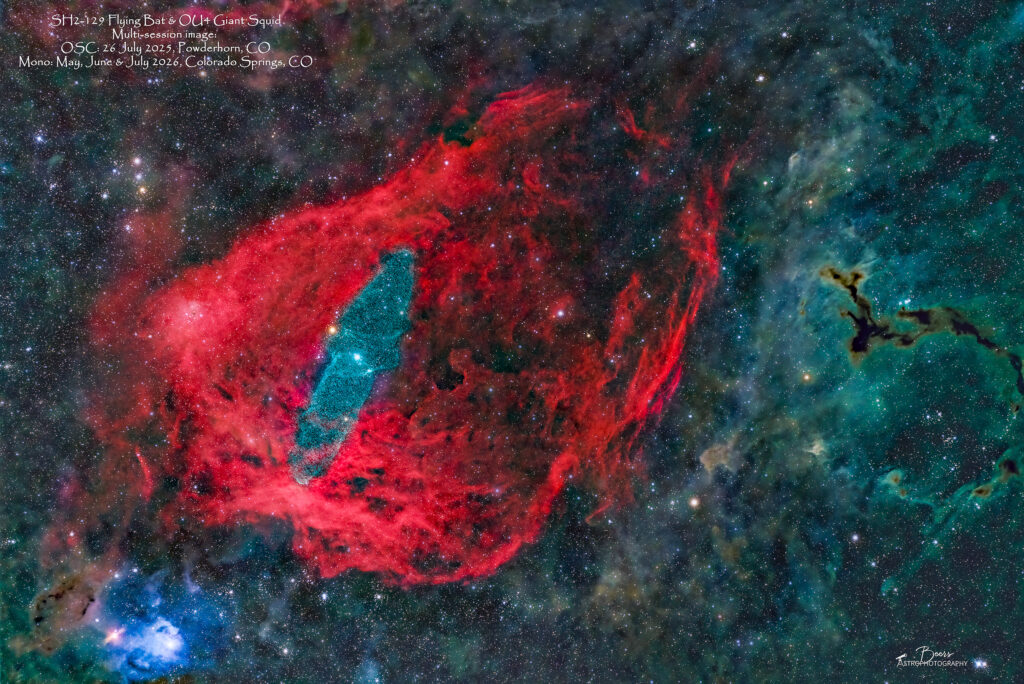
The summer project collecting data on my “OCD” target – SH2-129 Flying Bat / Ou4 Giant Squid continued through the clear sky nights on the front patio preceding the New Moon (11-14July2026) and my departure for EAA on 16 July 2026. July’s data collection mostly focused on collecting 15-minute subframes of OIII data.. This image, getting better but still a work in progress, is comprised of Ha and OIII data collected with the mono camera from the front patio on: 29 & 30 May 2026; 10, 11, 12, 16, 18, & 20 June 2026; and 11-14 July 2026. The mono data were again combined with OSC data captured in July 2025 at Powderhorn with the same telescope/reducer.
Capture & Processing Notes – May – July 2026
Capture Notes (July 2026 summary):
During the clear nights preceding the New Moon (11-14July2026) and my departure for EAA on 16 July 2026, I continued data collection on SH2-129/Ou4. July’s data collection mostly focused on collecting 15-minute subframes of OIII data.
…those data were captured and stacked into an image that is rotated 180° from all the previous months’ data. When the registration aligned the individual channels, it decided to use the latest data as the reference. I have no idea why! Thus this image is rotated 180° from this years’ version, but is the same as the November 2025 version of the image. I’m not sure that there’s a “right” way – so I’ll let the algorithm decide, and I’ll leave it alone!
I continued the practices that I’d learned last month (PHD2 Calibration Assistant prior to starting sequence, auto meridian flip), all four nights were mostly successful, with slightly different glitches around the meridian flip each night, mostly when AG failed to re-acquire after the flip or lost its guide star near/at the meridian (at precisely the moment I touched the laptop, when I came out to witness the meridian flip).
The process that I’ve settled into leading up to the capture of the first subframe:
- Connect all cables and electrical power connections
- Polar align with Polemaster, disconnect and stow
- Connect all equipment in SGP
- Run PHD2 Calibration Assistant:
- Slew, Calibrate, Cancel
- Stop guiding (do NOT close PHD2!)
- Park scope
- Run SGP sequence
- Slews to target, EAF #1
- Plate solves
- Resumes autoguider
- EAF#2
- Waits for AG to settle, Captures frame#1
The details of each night’s collection during July 2026 are in the Blog post: https://beersastrophotography.com/photography-journals/summer-data-collection-project-july-installment/
Image Data
The July edition of the SH2-129 Flying Bat and OU4 Giant Squid was created with the RGB data collected with the OSC camera in Powderhorn, CO on 26 July 2025; Mono camera Ha data collected during the imaging sessions throughout May, June, and July 2026, and OIII 15-minutes subframes collected in July 2026.
Total data included in RGB Combine algorithms to produce the July image: 2350min (39:10hrs)
July 2025 OSC Data – 26Jul2025: Gain 300, Offset 30, Temp 0°C; Total (good) OSC data capture: 67x5min = 335min (5:35hrs). Separated into R, G, B channels for RGB Combine with mono data
Total mono data used in image (May, Jun & Jul2026): 2015min (33:35 hours)
- OIII: 77x15min; 1155min, 19:15hrs
- Ha: 172x5min; 860min, 14:20hrs
Processing Summary
Stack: In APP, I stacked 100% (77/77) of the July OIII 15-minute subframes to create a new OIII.FITS. Stacked 100% of 172 Ha 5-minute subframes (172/172) captured on 29 & 30 May2026 and 10, 11, 12, 16, 18, & 20 Jun2026; and 13Jul2026 in APP, using multi-filter, 1st degree LNC, 3 iterations to create a new Ha.FITS.
Register: In APP, I registered (aligned) the new OIII.FITS and Ha.FITS with the previous months’ SII.FITS, RGB Mono.FITS, and RGB OSC separated channel.FITS; creating (R, G, B) Mono & OSC; H, S, O channel images registered with each other.
Combine: In APP, I used the RGB Combine tool to create three separate images, highlighting distinct aspects of the image, that I would ultimately blend together in LR/PS to create the final image. The APP RGB Combine algorithms were:
- RGB1: Combining the RGB OSC channels to create the dust background and the star field (I attempted to also combine the RGB mono channels, but all they contributed was light pollution)
- HaRGB1: Combining the RGB OSC channels with the mono Ha channel to create a richer red Flying Bat (with the Ha signal contributing red to the image).
- HOO1: Combined the Ha and OIII channels to create the OIII-dominant Giant Squid
Finally, I melded the three RGB Combined images together in Lightroom and Photoshop with a series of clipped layer masks to create the final image.
Shooting Location & Dates
OSC Data – 26 July 2026: BLM location named Tolvar Flats for its proximity to Tolvar Peak, on a flat mesa “overlooking” Blue Mesa Reservoir. (38° 19’ 2.40” N; 107° 11’ 18.30”W) at 8814.2 feet
Mono Data – 29 & 30 May, 10-12, 16, 18, 20 Jun, and 11-14 Jul 2026: HCH front patio, Colorado Springs, Colorado
Equipment
All equipment controlled by HP Probook (DSO CTRL1) running Sequence Generator Pro v4.5.0.1642
- Imaging (ASI2400-SC w 0.7x reducer): ZWO ASI2400MC imaging camera on Askar FRA600 108mm f/5.6 Quintuplet Petzval Flat-Field Astrograph (Southern Cross) with Askar f/3.9 Full Frame Reducer for FRA600
- RGB data: ZWO ASI2400MC imaging camera; (Southern Cross) Askar FRA600 108mm f/5.6 Quintuplet Petzval Flat-Field Astrograph with Askar 0.7x Reducer for Askar FRA600 108mm Astrograph
- Mono data: ZWO – ASI6200MM Pro Monochrome imaging camera; ZWO – EFW 7×2″ Filter Wheel with installed filters: Svbony SV227 2” Narrow-Band – SII, Ha, OIII
Optolong LRGB Filter Set (2″) (1=SII, 2=Ha, 3=OIII, 4=Lum, 5=Red, 6=Grn, 7=Blue); (Southern Cross) Askar FRA600 108mm f/5.6 Quintuplet Petzval Flat-Field Astrograph with Askar 0.7x Reducer for Askar FRA600 108mm Astrograph
- Mount: Rainbow Astro RST-135E (controlled by iHubo ASCOM driver)
- Polar alignment: QHYCCD camera (controlled by Polemaster for polar alignment)
- Autoguiding: Orion 60mm Multi-Use Guide Scope with ZWO ASI120MM mini mono camera (controlled by PHD2)
- Auto Focuser: ZWO EAF Electronic Automatic Focuser – Standard (EAF-5V-STD)
The Summer 2026 Project Continues: May-June 2026 version
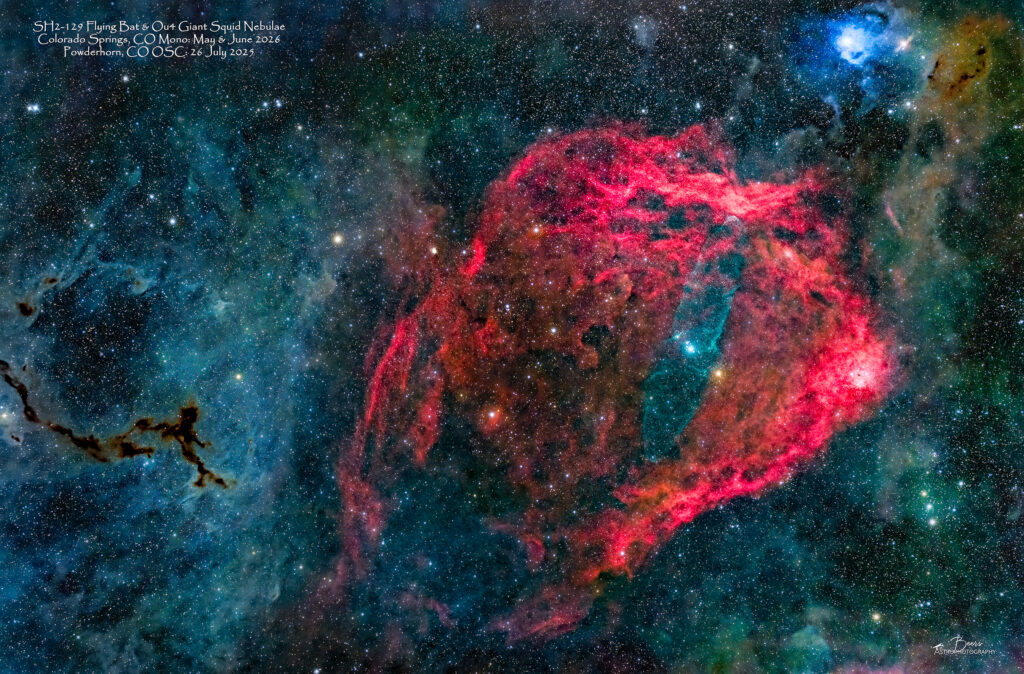
The summer project collecting data on my “OCD” target – SH2-129 Flying Bat / Ou4 Giant Squid continued through the clear sky nights on the front patio throughout June 2026. This image, getting better, but still a work in progress is comprised of data collected with the mono camera from the front patio on: 10, 11, 12, 15, 16, 17, 18, and 20 June 2026; added to the mono data in last month’s “summer project kick-off image” collected 15, 16, 23, 29, and 30 May 2026. The mono data are again combined with data captured in July 2025 at Powderhorn with the same telescope/reducer and the one-shot color camera.
Capture & Processing Notes
Capture Notes (June 2026 summary):
I continued the data collection on SH2-129/Ou4 during the clear nights surrounding June 2026’s New Moon (10-12Jun) and during the following week while it was still setting late and in its first quarter (15-20Jun).
Throughout the month, I did manage to drive out/resolve a few lingering data collection errors/issues:
- I discovered that the pointer to the ANSVR plate solver was pointing to the directory where the database was stored, rather than where the .exe. file was located. When I changed that pointer to the right location, it did away with the error message I was getting at each start-up (that I’d been ignoring, but being irritated by!).
- To address the lingering PHD2 warning “calibration too far from the meridian, recalibration needed”, I reached out to PHD2 Forum. Brian and Kent both told me I should run the Calibration Assistant (CA) at the beginning of the night’s activities then select “restore calibration” in the PHD2 settings to both save time during nightly imaging and get a better calibration result. I doubted that I could reach the required Dec=0° from my front patio shooting location – but found that it’s much higher in the southern sky than I anticipated! Finally, on the last night of my June imaging extravaganza – 20 June – I had the courage to try the PHD2 CA – I found it to be easy, quick, and work like a charm! It is now the step in my nightly start-up workflow immediately following the polar alignment, before I kick off the SGP sequence.
- In using SGP’s Flat Calibration Assistant throughout the month, I finally figured out all its nuances – the flat frame exposure value for each filter is saved in the equipment profile, then when you add a target using that profile and select “flat” it auto populates that exposure length. The second issue I was experiencing with the calibration frame collection was camera disconnects. I submitted a Help Ticket to the SGP Forum, Ken replied with a number of possible issues (cables, USB hub, etc.). At the end of his message stating, “you might try putting a 5 second pre-capture delay” into the target. That worked like a charm in capturing a full set of calibration frames for SC420-Mono at 0° camera angle that stacked and combined easily without errors in APP (the set I’d captured in late May would not stack).
The details of each night’s collection during June 2026 are in the Blog post: https://beersastrophotography.com/photography-journals/summer-data-collection-project-june-installment/
The details of each night’s collection during May 2026 are in the Blog post: https://beersastrophotography.com/photography-journals/its-back-flying-bat-giant-squid-visible-again/
The details of the data collection from Powderhorn, Colorado (dark skies image with one-shot color camera (OSC)) in July 2025 are in the Blog post: https://beersastrophotography.com/photography-journals/one-night-beast-recon-trip-to-tolvar-flats/
Image Data
A total of 59:55 hours of RAW mono data was used to create this image (with 24:40 hours of OIII to create the Giant Squid)!
Total Mono Data (May & Jun 2026): 3595min (59:55 hours)
- Lum: 16x1min = 16min
- OIII: 24x5min; 136x10min = 1480min, 24:40hrs
- Ha: 143x5min = 715min, 11:55hrs
- SII: 122x5min = 610min, 10:10hrs
- Red: 90x3min = 270min, 4:30hrs
- Green: 90x3min = 270min, 4:30hrs
- Blue: 78x3min = 234min, 3:54hrs
May Mono Data– 15, 16, 23, 29, 30May2026: Gain 100, Offset 50, Temp 0°C. Total mono data capture: 16x1min, 122x5min, 56x10min subframes = 1186min (19:46hr).
- Lum: 16x1min; 16min
- OIII: 24x5min, 56x10min; 680min, 11:20hrs
- Ha: 40x5min; 200min, 3:20hrs
- SII: 58x5min; 290min, 4:50hrs
June Mono Data– 10, 11, 12, 15, 16, 17, 18, 20Jun2026: Gain 100, Offset 50, Temp 0°C. Total mono data capture: 258x3min, 167x5min, 80x10min subframes = 2,409min (40:09hr).
- OIII: 80x10min = 800min, 11:20hrs
- Ha: 103x5min; 515min, 8:35hrs
- SII: 64x5min; 320min, 5:20hrs
- Red: 90x3min; 270min, 4:30hrs
- Green: 90x3min; 270min, 4:30hrs
- Blue: 78x3min; 234min, 3:54hrs
July 2025 OSC Data – 26Jul2025: Gain 300, Offset 30, Temp 0°C; Total (good) OSC data capture: 67x5min = 335min (5:35hrs). Separated into R, G, B channels for RGB Combine with mono data
Processing Summary
I stacked 95% of the 691 available mono light frames (656/691), using data captured on 15, 16, 23, 29, and 30 May 2026, and 10, 11, 12, 15, 16, 17, 18, and 20 June 2026. The APP stacking algorithm produced individual R, G, B, H, S, and O channel images; I did not use the luminance data.
I then stacked the one-shot color (OSC) data collected on 26 July 2025 from Powderhorn, Colorado. Once stacked, I separated the OSC image into its individual R, G, and B channels.
Next, I registered (aligned) all of the individual channel images so that the corresponding channels would line up precisely when combined into a single color image for further processing in Photoshop and Lightroom. When creating the individual color images with APP’s RGB Combine tool, I used both the mono and OSC R, G, and B channels in the algorithms that called for them.
Shooting Location
OSC Data – 26 July 2026: BLM location named Tolvar Flats for its proximity to Tolvar Peak, on a flat mesa “overlooking” Blue Mesa Reservoir. (38° 19’ 2.40” N; 107° 11’ 18.30”W) at 8814.2 feet
Mono Data – 15, 16, 23, 29, 30 May 2026 & 10, 11, 12, 15, 16, 17, 18, 20 Jun 2026: HCH front patio, Colorado Springs, Colorado
Equipment
All equipment controlled by HP Probook (DSO CTRL1) running Sequence Generator Pro v4.5.0.1642
- Imaging (ASI2400-SC w 0.7x reducer): ZWO ASI2400MC imaging camera on Askar FRA600 108mm f/5.6 Quintuplet Petzval Flat-Field Astrograph (Southern Cross) with Askar f/3.9 Full Frame Reducer for FRA600
- RGB data: ZWO ASI2400MC imaging camera; (Southern Cross) Askar FRA600 108mm f/5.6 Quintuplet Petzval Flat-Field Astrograph with Askar 0.7x Reducer for Askar FRA600 108mm Astrograph
- Mono data: ZWO – ASI6200MM Pro Monochrome imaging camera; ZWO – EFW 7×2″ Filter Wheel with installed filters: Svbony SV227 2” Narrow-Band – SII, Ha, OIII
Optolong LRGB Filter Set (2″) (1=SII, 2=Ha, 3=OIII, 4=Lum, 5=Red, 6=Grn, 7=Blue); (Southern Cross) Askar FRA600 108mm f/5.6 Quintuplet Petzval Flat-Field Astrograph with Askar 0.7x Reducer for Askar FRA600 108mm Astrograph
- Mount: Rainbow Astro RST-135E (controlled by iHubo ASCOM driver)
- Polar alignment: QHYCCD camera (controlled by Polemaster for polar alignment)
- Autoguiding: Orion 60mm Multi-Use Guide Scope with ZWO ASI120MM mini mono camera (controlled by PHD2)
- Auto Focuser: ZWO EAF Electronic Automatic Focuser – Standard (EAF-5V-STD)
The Summer 2026 Project Begins: HCH Mono (May 2026) & Dark Skies (OSC, July 2025)
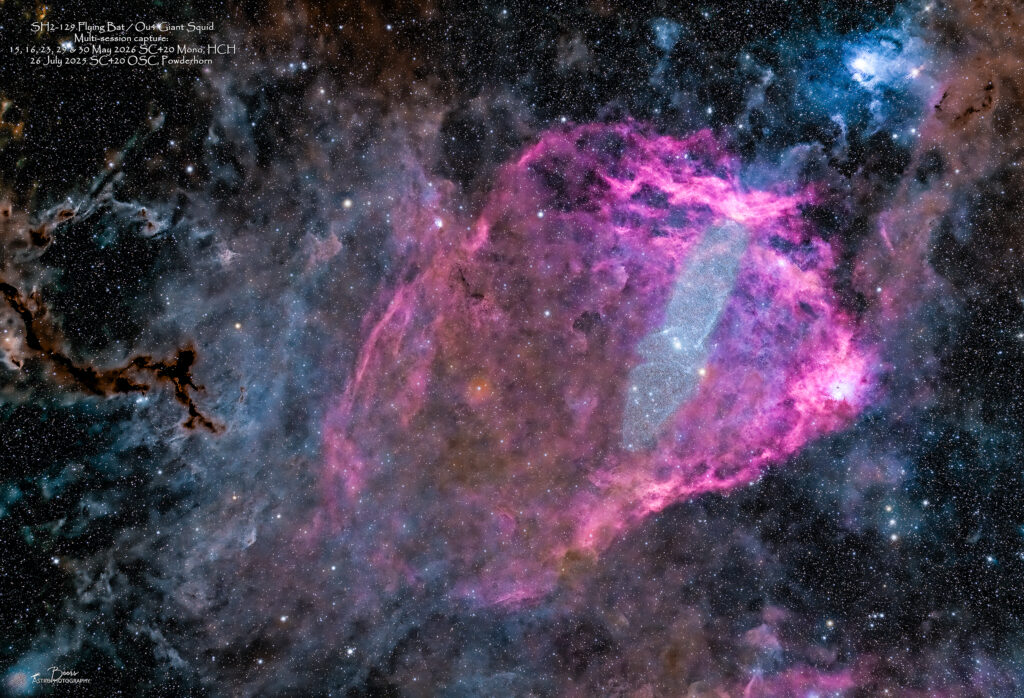
Back from Chile (astrophotography trip, 13-24Mar2026) and back from Australia (work trip, 24Apr-8May2026), the May 2026 New Moon weekend, partially clear at home, allowed me to dust off the mono imaging camera and take the new version of Sequence Generator Pro (SGP v4.5.0.1638 (released 24 Apr 2026)) for a test drive. This started a month’s long visit back to my “OCD” target – SH2-129 Flying Bat / Ou4 Giant Squid. This image, definitely a work in progress (likely all throughout the summer and early fall while it’s visible) is comprised of data collected with the mono camera from the front patio on: 15, 16, 23, 29, and 30 May 2026. The mono data are combined with data captured in July 2025 at Powderhorn with the same telescope/reducer and the one-shot color camera.
Capture & Processing Notes
BLUF: Back from Chile (astrophotography trip, 13-24Mar2026) and back from Australia (work trip, 24Apr-8May2026), the May 2026 New Moon weekend was partially clear at home to allow me to dust off the mono imaging camera and take the new version of Sequence Generator Pro (SGP v4.5.0.1638 (released 24 Apr 2026)) for a test drive. This started a month-long visit back to my “OCD” target, the SH2-129 Flying Bat / Ou4 Giant Squid. This image, is definitely a work in progress and likely will continue to be the target of choice throughout the summer and fall while it’s visible. It is comprised of 19:46 hours of data collected with the mono camera from the front patio on: 15-16 May 2026 (between SW/HW set-up issues on 15 May and a random sequence abort on 16 May – less than a stellar collection period of 4:40 across two nights); 23 May 2026 (successful collect in the short hours of darkness yielded 4:43 hours of data, including 20 x 10 minute subframes of OIII in my quest of capturing the Giant Squid); 29 May 2026 (a whopping 5:53hrs), and 30 May 2026 (an hour plus delay waiting for the bank of clouds right where the target was to clear, yielding 4:30hrs). The mono data were combined with 5:35 hours of data captured in July 2025 at Powderhorn with the same telescope/reducer and the one-shot color camera.
The details of each night’s collection are in the Blog post: https://beersastrophotography.com/photography-journals/its-back-flying-bat-giant-squid-visible-again/
Image Data & Processing Summary
A total of 20:21 hours of RAW data was used to create this image. It is a stack of 99% of 192 mono camera light frames captured on 15, 16, 23, 29, & 30 May2026 in APP; creating L, H, S, O channel images. Combined with the OSC camera data captured from Powderhorn on 26 July 2025; separated into R, G, B channels. Ultimately combined using APP’s RGB combine tool using the RGBHOO algorithm.
(Mono Data– 15, 16, 23, 29, 30May2026): Gain 100, Offset 50, Temp 0°C. Total mono data capture: 16x1min, 122x5min, 56x10min subframes = 1186min (19:46hr).
- Lum: 16x1min; 16min
- OIII: 24x5min, 56x10min; 680min, 11:20hrs
- Ha: 40x5min; 200min, 3:20hrs
- SII: 58x5min; 290min, 4:50hrs
(OSC Data – 26Jul2025): Gain 300, Offset 30, Temp 0°C; Total (good) OSC data capture: 67x5min = 335min (5:35hrs). Separated into R, G, B channels for RGB Combine with mono data
Shooting Location & Dates
OSC Data – 26Jul2025: BLM location named Tolvar Flats for its proximity to Tolvar Peak, on a flat mesa “overlooking” Blue Mesa Reservoir. (38° 19’ 2.40” N; 107° 11’ 18.30”W) at 8814.2 feet
Mono Data – 15, 16, 23, 29, 30 May 2026: HCH front patio, Colorado Springs, Colorado
Equipment
All equipment controlled by HP Probook running Sequence Generator Pro v4.4.1.1441.
- Imaging (ASI2400-SC w 0.7x reducer): ZWO ASI2400MC imaging camera on Askar FRA600 108mm f/5.6 Quintuplet Petzval Flat-Field Astrograph (Southern Cross) with Askar f/3.9 Full Frame Reducer for FRA600
- RGB data: ZWO ASI2400MC imaging camera; (Southern Cross) Askar FRA600 108mm f/5.6 Quintuplet Petzval Flat-Field Astrograph with Askar 0.7x Reducer for Askar FRA600 108mm Astrograph
- Mono data: ZWO – ASI6200MM Pro Monochrome imaging camera; ZWO – EFW 7×2″ Filter Wheel with installed filters: Svbony SV227 2” Narrow-Band – SII, Ha, OIII
Optolong LRGB Filter Set (2″) (1=SII, 2=Ha, 3=OIII, 4=Lum, 5=Red, 6=Grn, 7=Blue); (Southern Cross) Askar FRA600 108mm f/5.6 Quintuplet Petzval Flat-Field Astrograph with Askar 0.7x Reducer for Askar FRA600 108mm Astrograph
- Mount: Rainbow Astro RST-135E (controlled by iHubo ASCOM driver)
- Polar alignment: QHYCCD camera (controlled by Polemaster for polar alignment)
- Autoguiding: Orion 60mm Multi-Use Guide Scope with ZWO ASI mini mono camera (controlled by PHD2)
- Auto Focuser: ZWO EAF Electronic Automatic Focuser – Standard (EAF-5V-STD)
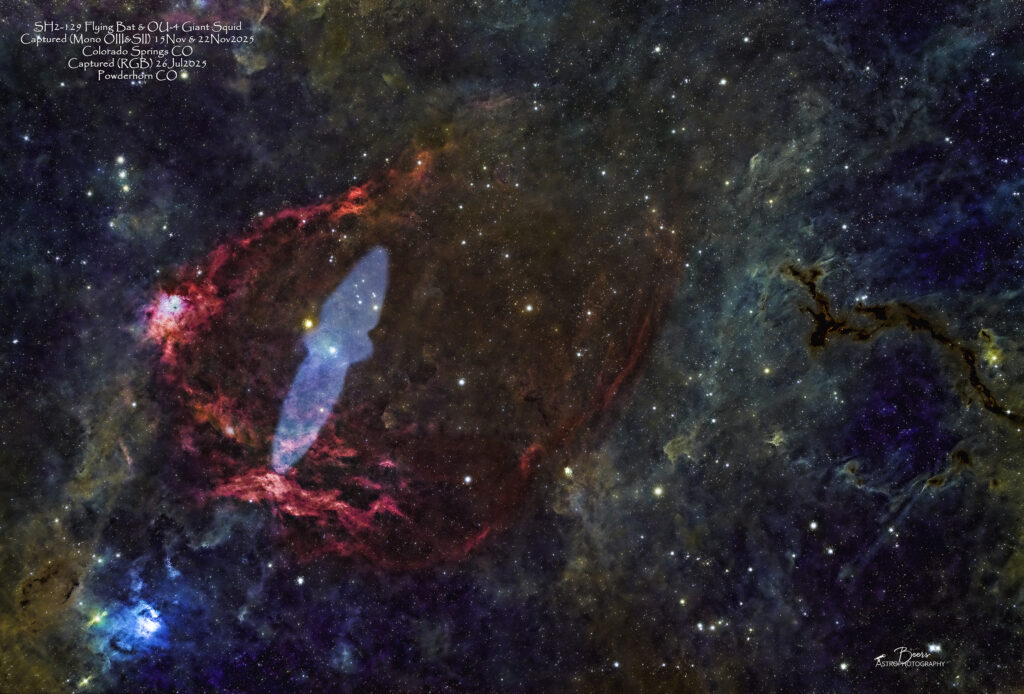
Dark Skies (OSC, July 2025) & Mono imaging (Nov 2025) first experience
This image is comprised of data from two separate first light experiences! The OIII data that reveals the OU-4 Giant Squid (the blue nebula that looks like a bat (?)) was captured using my new ZWO ASI6200MM mono camera with the OIII filter mounted into my new ZWO EFW filter wheel. So, the OU-4 Giant Squid is first light with the monochromatic camera and filter wheel! The mono data was combined with the RBG data captured during our July 2025 dark skies trip to Tolvar Flats (near Powderhorn, Colorado). The RGB data was first light with my then-newest imaging stream addition – the Askar f/3.9 0.7x Full Frame Reducer for the Askar FRA600. So, the SH-2 Flying Bat and the rest of the deep sky background was first light of the telescope with the 0.7x reducer!
Capture & Processing Notes
This image is filled with first light! The OIII data that (finally) reveals the OU-4 Giant Squid (the blue nebula that looks like a bat (?)) was captured using my new ASI6200MM mono camera with the OIII filter mounted into my new ZWO EFW filter wheel. Thus, first light with the monochromatic camera and filter wheel! Then the mono data was combined with the RBG data captured during our July 2025 dark skies trip to Tolvar Flats (near Powderhorn, Colorado), which was first light with my then-newest imaging stream addition – the Askar f/3.9 0.7x Full Frame Reducer for the Askar FRA600 telescope (the Southern Cross). (See the story of that adventure and data capture immediately below…which shows the Flying Bat (the red nebula that looks like a squid (?)) but only a slight blue hint of the Giant Squid.
15 November 2025: Having gotten my Christmas cards created, produced, and addressed; and the calendars created and produced by Veterans Day (yes, really!) I returned my attention to assembling and loading the control software for my birthday present the ZWO ASI6200MM and ZWO Electronic Focus Wheel (EFW). Putting the mono camera, filter wheel, and its control software together; the completion and opening of the front patio for imaging after a 7+ month hiatus due to a house renovation; and a clear night near the New Moon all came to fruition on Saturday night, 15 November 2025.
The sequence start-up had a couple of bumps – neither of which were associated with the new equipment. First, the new version of the ASCOM platform (v7.1) is 64 bit and couldn’t use the SSAG Pro’s (autoguider camera) 32 bit ASCOM driver. That error surfaced when the equipment was first connected. I went searching for an updated SSAG Pro ASCOM driver (thus the reason for wanting to do this first use on the front patio vs. in dark skies where I had no internet connection). The search ended when I discovered that Orion has gone out of business (so much for contacting the manufacturer) and all the forum locations where people had stashed drivers were either inaccessible or empty. I decided to ignore the error message and proceed (vowing to drop back to ASCOM Platform 6.2 in the morning). Surprisingly enough, that approach worked!
Second, as with previous experiences with a new element in the imaging train, the autofocuser struggled with producing a parabola that was acceptable (even though the “V” clearly identified a good focal point). I’ll need to spend some time on a clear night running the focuser step size/number of steps algorithm to find the right settings – and to determine the offsets between filters. But for this evening, I decided that I wanted to gather data (i.e., actually have an image from my “first light” experience) so I cancelled the autofocus routine set to run on the hour during the sequence and settled for the focus point that had the “V’s” minimum HFR.
By the time I got the sequence started, it was well past the meridian flip, so I imaged from 21:17 until target set below the house roof line at 01:25, capturing 43×5 minutes OIII subframes.
22 November 2025: Unexpectedly, we had a (partial) clear night within the “New Moon weekend” so I decided to take advantage of it to capture more data on the SH2-129. Before I started, I went online to Telescopius and found images of SH2-129 that had the glassy look of the OU-4 Giant Squid that I’m striving for. All those images were using an exposure length of 450 or 600 seconds for the OIII, so I opted for 600 seconds. I also added gathering data with the SII filter (5 minute exposures) since that filter seemed to pick up much more on the SH2-240 Spaghetti Nebula than the OIII filter did.
Everything went well with the sequence start up – except for the autofocuser – again, it would find a perfectly good minimum on the “V” (in this case, 8902 with a HFR of 1.6) but couldn’t fit a parabola and threw a “can’t find focus” error. So, again, I turned off the autofocus throughout the sequence. I got the sequence started at 17:49MST (threw away the first light frame as it seemed to be much brighter than the rest). I ended the sequence at about 01:00MST when it was approaching the roofline, captured flat, dark flat, and bias frames.
Since it was still clear, I set up to also gather more data on SH2-240 (more S-H-O data and also R-G-B data to create the starfield). I experimented with changing the EAF settings to 9 steps at 125 step size – the AF#1 (at the start of the session before the final plate solve) resolved at 8927, 2.7HFR, 92% fit; leading me to believe that I had guessed correctly on the steps/step size setting. Only to be foiled by AF#2 (after the final plate solve) that again had the bottom of the “V” at position 8927 with an HFR of 1.6 but threw the same “can’t find focus, expanding the focus range” error. ARGH. So, again, I cancelled the autofocus routine which kicked the sequence off and running in collecting the first subframe.
Shortly after I went into the control panel to turn off the EAF for the rest of the sequence, I got an error message that the EAF had been manually disconnected. It’s looking like there is a kink in the cable (not unexpected, since the bottom of the 90° cable is pointed upward while the cable hangs downward during operation – it’s probably time to change out that cable with a new USB A to USB B cable). As I was sitting on my stool waiting for the first subframe to complete, I glanced upward – hmmm, those look like streaks of clouds. Sure enough, the sky was clouding up – just as predicted by WeatherUnderground! By the time I convinced myself, yes indeed, those were clouds and they were going to continue to get thicker vs. dissipating, I was into the second subframe. I let that run to fruition (amazingly enough the autoguider was tracking well) – then ended the sequence and took everything inside for the night. …so there was not a second set of data to add to the “first light” of the SH2-240 Spaghetti Nebula captured on the previous Saturday night.
Sequence plan (OSC Data – 26Jul2025): Gain 300, Offset 30, Temp 0°C; 72x5min. Captured 26Jul2025, 2218MDT – 27Jul2025, 0508MDT. Total exposure time: 6:00. (Five frames marked BAD, 27Jul2025, 0442 – 0508MDT)
Sequence plan (Mono Data (OIII filter) – 15Nov2025): Gain 100, Offset 30, Temp 0°C; 43x5min. Captured 15Nov2025, 21:17MST – 16Nov2025, 01:25MST. Total imaging time: 215 minutes; 3:35 hours.
Sequence plan (Mono Data (SI & OIII filter) – 22Nov2025): Gain 100, Offset 30, Temp 0°C; 25x10min, OIII (250min, 4:10hrs) and 33x5min, SII (165min, 2:45hrs). Captured 22Nov2025, 17:47MST – 23Nov2025, 00:57MST. Total imaging time: 415minutes, 6:55hrs (OIII (250min, 4:10hrs), SII (165min, 2:45hrs)).
Shooting location (OSC Data – 26Jul2025): A new BLM location named Tolvar Flats for its proximity to Tolvar Peak, on a flat mesa “overlooking” Blue Mesa Reservoir. (38° 19’ 2.40” N; 107° 11’ 18.30”W) at 8814.2 feet
Shooting location (Mono Data (SI & OIII filter) – 22Nov2025): HCH Front Patio (back in commission after 7 months of renovation!), Colorado Springs, Colorado
Processing summary: Captured with SGP. Stacked in APP using Adaptive Airy. Star removal with Starnet++. Processed in LR/PS.
Equipment
All equipment controlled by HP Probook running Sequence Generator Pro v4.4.1.1441.
- Imaging (ASI2400-SC w 0.7x reducer): ZWO ASI2400MC imaging camera on Askar FRA600 108mm f/5.6 Quintuplet Petzval Flat-Field Astrograph (Southern Cross) with Askar f/3.9 Full Frame Reducer for FRA600
- RGB data: ZWO ASI2400MC imaging camera; (Southern Cross) Askar FRA600 108mm f/5.6 Quintuplet Petzval Flat-Field Astrograph with Askar 0.7x Reducer for Askar FRA600 108mm Astrograph
- Mono data: ZWO – ASI6200MM Pro Monochrome imaging camera; ZWO – EFW 7×2″ Filter Wheel with installed filters: Svbony SV227 2” Narrow-Band – SII, Ha, OIII
Optolong LRGB Filter Set (2″) (1=SII, 2=Ha, 3=OIII, 4=Lum, 5=Red, 6=Grn, 7=Blue); (Southern Cross) Askar FRA600 108mm f/5.6 Quintuplet Petzval Flat-Field Astrograph with Askar 0.7x Reducer for Askar FRA600 108mm Astrograph
- Mount: Rainbow Astro RST-135E (controlled by iHubo ASCOM driver)
- Polar alignment: QHYCCD camera (controlled by Polemaster for polar alignment)
- Autoguiding: Orion 60mm Multi-Use Guide Scope with Orion StarShoot AutoGuider Pro Mono Astrophotography Camera (controlled by PHD2)
- Auto Focuser: ZWO EAF Electronic Automatic Focuser – Standard (EAF-5V-STD)
Dark Skies: OSC camera on Southern Cross with 0.7x reducer – Tolvar Flats (near Powderhorn), Colorado
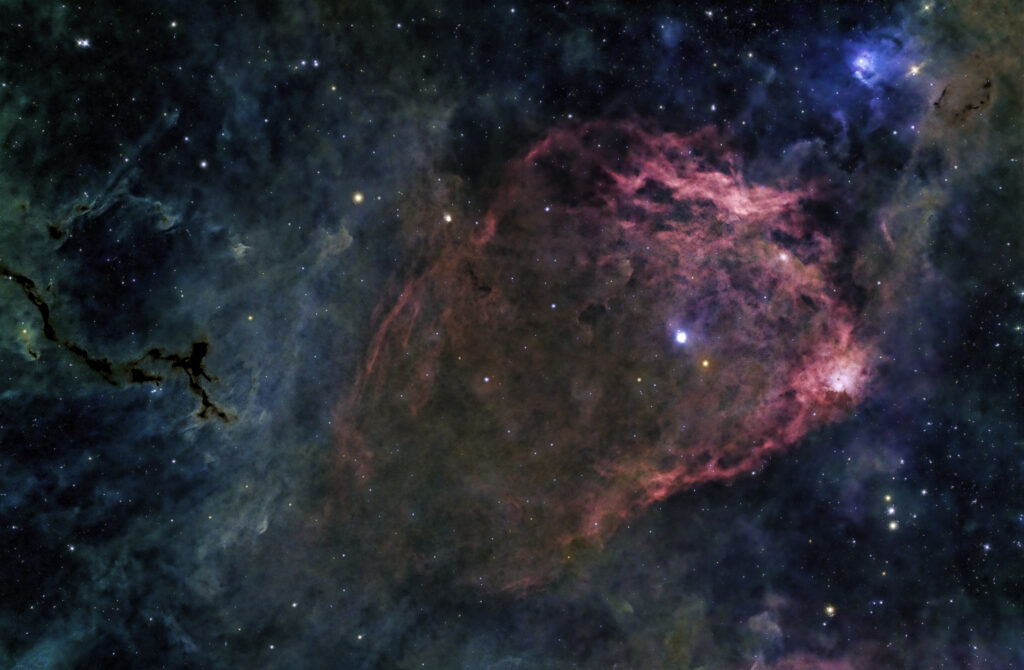
A quick one-night “recon trip” to BLM land near Powderhorn, Colorado afforded one-night in clear dark skies (only our second of 2025!) to wring out the cobwebs of our camping and Beast-based imaging routines. If you’ve only got one night – you make the most of it – so it was SH2-129 Flying Bat and the Milky Way!! ...and this was first light with my newest imaging stream addition – the Askar f/3.9 0.7x Full Frame Reducer for the Askar FRA600
Capture & Processing Notes
The data for this image were captured during a one-night quick trip to the Powderhorn, Colorado area. The trip was meant as more of a recon trip for our August anniversary dark skies trip but since the skies were clear, I decided to take the Southern Cross and its new Askar 0.7x reducer to give it a try, gathering some more data on the elusive SH2-129 Flying Bat/OU-4 Squid Nebulae.
We got an “early” start (it would have been earlier, if the Beast’s canopy hadn’t spontaneously deployed and we had to take the time to research on YouTube – how to disconnect and retract it by hand – it’s always something!). Even with that ~one hour delay, we arrived in the Powderhorn area (after a stop in Gunnison for fuel and a most excellent hamburger from the food truck parked beside the gas station) at about 1330MDT. We were looking for a site in the trees that we’d found during our way out of camp in July 2023. We took Hwy50 West, turned south on CR149 (Silver Thread Scenic Byway), and then after CR149 turned to the West, we turned north onto CR26 (Lake City Cutoff Road). We searched along CR26 for areas where we could camp and ended up at a flat (although there were a LOT of rocks (i.e., tripping hazards) and somewhat treed area just off of BLM 3014D that we chose for our night’s camp.
I suggested that we not set up the full camp (ground cover, canopy, stove, etc) for a one-night stay, but we did… After doing the camp set-up, I starting to set up my equipment at about 1530…periodically looking at the grey and storm-threatening clouds. Once I had the mount leveled, roughly aligned, and the telescope mounted on it, I asked Paul his opinion of the impending rain. “Yes, it’s going to rain. It’s going to clear up at about 2000MDT.” So, I took the telescope off the mount, and covered the tripod/mount with a waterproof tarp – took Zeus for a walk and had dinner.
At about 1900, I ventured out to begin assembling the rest of the equipment – it was still pretty cloudy and there were a few sprinkles – but I was balancing that with the impending darkness, so I pushed forward. At astronomical twilight (2130MDT), the clouds cleared to the north, so I started the polar alignment. By the time I was done with that (which took a very small fraction of the time it does in the Southern Hemisphere – THANK YOU Polaris!!), all the clouds had cleared!
I had set up the mount for its new location (using the hand controller) when I originally set up the mount (but not the telescope) – convincing / adjusting its settings from their last Southern Hemisphere use to their current location. The Polemaster software also came up in Southern Hemisphere, but that was a quick fix to change. I got the sequence started, the telescope and autoguider scope focused and then started the sequence. I had one round of CW/CCW/CW/CCW until the plate solving failed. (I put in my notes (and probably should put on the camera body or telescope rotation point) – CW is rotate to the LEFT!) I rebooted everything, put the camera back at the 90° angle that the plan called for and started up again. The second attempt went well, with only one 9° rotation in the correct direction, and I was off to the races. With the first subframe captured at 22:18MDT.
I got up at about 02:00MDT to do the meridian flip and then got up at 05:00MDT (at the start of Nautical twilight) to end the sequence. I ended up marking about 5 subframes as bad (too light) which were taken at or after the start of Astronomical twilight (nighttime ends).
The version #1 processing again has the OU-4 Giant Squid Nebula hidden within the Ha-dominant SH2-129 Flying Bat, although a lot of interesting blue and green came out in this image, using the f3.9 Askar 0.7x reducer under dark skies. I attended Nico Carver’s 3 August 2025 Patreon Sunday Chat to ask the question if it is at all possible to capture this image (including with the OU-4 visible) using a one shot color (OSC) camera. He stated, given enough data and HaOIII extract OIII processing should make it possible. Thus, the data comprising the v1 image below will be added to the other data I’ve collected on this target to continue processing future versions…
Sequence plan: Gain 300, Offset 30, Temp 0°C; 72x5min. Captured 26Jul2025, 2218MDT – 27Jul2025, 0508MST. Total exposure time: 6:00. (Five frames marked BAD at end of sequence, 27Jul2025, 0442 – 0508MDT)
Shooting location: A new BLM location was are calling Tolvar Flats due to its proximity to Tolvar Peak, on a flat mesa “overlooking” Blue Mesa Reservoir. (38° 19’ 2.40” N; 107° 11’ 18.30”W) at 8814.2 feet (2686.56m)
Processing summary: Captured with SGP. Stacked in APP using Adaptive Airy. Star removal with Starnet++. Processed in LR/PS.
Equipment
All equipment controlled by HP Probook running Sequence Generator Pro v4.4.1.1441.
- Imaging (ASI2400-SC w 0.7x reducer): ZWO ASI2400MC imaging camera on Askar FRA600 108mm f/5.6 Quintuplet Petzval Flat-Field Astrograph (Southern Cross) with Askar f/3.9 Full Frame Reducer for FRA600
- Mount: Rainbow Astro RST-135E (controlled by iHubo ASCOM driver)
- Polar alignment: QHYCCD camera (controlled by Polemaster for polar alignment)
- Autoguiding: Orion 60mm Multi-Use Guide Scope with Orion StarShoot AutoGuider Pro Mono Astrophotography Camera (controlled by PHD2)
- Auto Focuser: ZWO EAF Electronic Automatic Focuser – Standard (EAF-5V-STD)
HCH Front Patio imaging: OSC camera with LeX and OIII filters
Capture & Processing Notes
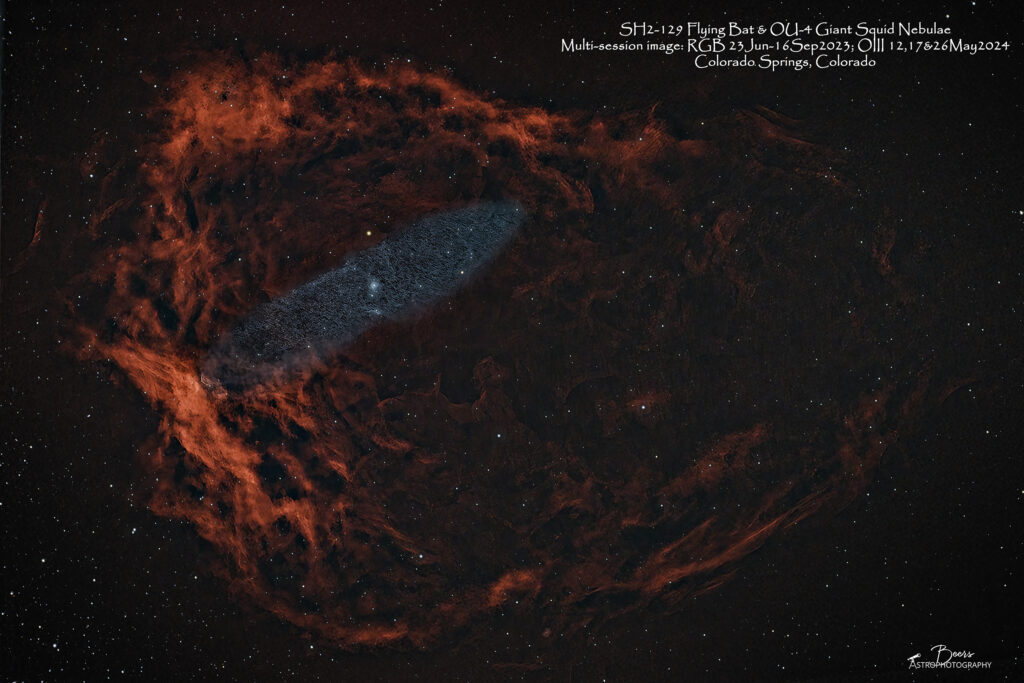
With the beginning of visibility of nebulae, I’ve continued my obsession (started in June 2023) of imaging the SH2-129 Flying Bat and OU-4 Giant Squid Nebulae. Since I was imaging from HCH, Colorado Springs, I decided to capture more data with the OIII filter to supplement the data captured last year on the OU-4 Giant Squid Nebula (the blue region of the image).
Used the data in conjunction with the other data I’ve captured on SH2-129/OU-4 listed below
Composite image’s session sequence plans:
Image was created by registering:
- SH2-129 Flying Bat Combine v2 – RGBHOO (created 10Jan2024)
- SH2-129 4sessionLeX – 23Jun-16Sep (lpg-cbg and StarCal)
- SH2-129 Flying Bat – ASI2400SC with OIII filter – 12&17May2024
- SH2-129 Flying Bat – ASI2400SC with OIII filter – 26May2024
RGBHOO: RGBHOO image, created from the four sessions captured in 23Jun-16Sep2023 using the RGB combine tool to create an RGBHOO image (used the .fits files created on 10Jan2024). Four sessions captured with the LeX filter were combined using Ha-OIII Color, Ha-OIII extract Ha, and Ha-OIII extract OIII. The two sessions 15-16Jul2023 were used as the second OIII channel in the RGBHOO image. Four sessions combined to create the RGB with Ha-OIII Color, Ha with HaOIII extract Ha, OIII with HaOIII extract OIII APP algorithms
- Sequence #1 (23Jun2023): Gain: 300, Temp: -0°C, offset=NotSet. 38x10min. Captured 23Jun2023, 2140MDT – 23Jun2023, 0428MDT. Total exposure time: 6:20hrs. (HCHASI2400#1SCLeX)
- Sequence #2 (1Jul2023): Gain: 300, Temp: -0°C, offset=NotSet. 21x10min. Captured 1Jul2023, 2155MDT – 2Jul2023, 0444MDT (with gap 0226-0333MDT), deleted first and last image too much light. Total exposure time: 3:10hrs. (HCHASI2400#1SCLeX)
- Sequence #3 (2Jul2023): Gain: 300, Temp: -0°C, offset=NotSet. 31x10min. Captured 2Jul2023, 2210MDT – 3Jul2023, 0436MDT (deleted last image). Total exposure time: 5:10hrs. (HCHASI2400#1SCLeX)
- Sequence #4 (16Sep2023): Gain: 300, Temp: -0°C, offset=30; 31x10min. Captured 16 Sep2023 (16Sep2023, 2107MDT – 0301MDT). Total exposure time: 5:10hrs.
Two sessions of OIII, using OIII Color algorithm
- Sequence #1 (15Jul2023): Gain: 300, Temp: -0°C, offset=NotSet. 24x10min. Captured 15Jul2023, 2258MDT – 16Jul2023, 0440MDT. Total exposure time: 5:10hrs. (HCHASI2400#1SCOIII)
- Sequence #2 (16Jul2023): Gain: 300, Temp: -0°C, offset=NotSet. 23x10min. Captured 16Jul2023, 2209MDT – 17Jul2023, 0411MDT. Total exposure time: 3:50hrs. (HCHASI2400#1SCOIII)
RGB: Four LeX sessions combined to create the RGB with Ha-OIII Color. Used the Star Calibration Tool to create a correctly colored star field (rather than the predominant red that is in the LeX version.
- Sequence #1 (23Jun2023): Gain: 300, Temp: -0°C, offset=NotSet. 38x10min. Captured 23Jun2023, 2140MDT – 23Jun2023, 0428MDT. Total exposure time: 6:20hrs. (HCHASI2400#1SCLeX)
- Sequence #2 (1Jul2023): Gain: 300, Temp: -0°C, offset=NotSet. 21x10min. Captured 1Jul2023, 2155MDT – 2Jul2023, 0444MDT (with gap 0226-0333MDT), deleted first and last image too much light. Total exposure time: 3:10hrs. (HCHASI2400#1SCLeX)
- Sequence #3 (2Jul2023): Gain: 300, Temp: -0°C, offset=NotSet. 31x10min. Captured 2Jul2023, 2210MDT – 3Jul2023, 0436MDT (deleted last image). Total exposure time: 5:10hrs. (HCHASI2400#1SCLeX)
- Sequence #4 (16Sep2023): Gain: 300, Temp: -0°C, offset=30; 31x10min. Captured 16 Sep2023 (16Sep2023, 2107MDT – 0301MDT). Total exposure time: 5:10hrs.
OIII: Two separate images (one image with data from 12&17May2024 stacked together; one image with data gathered on 26May2024 were registered, captured with the OIII filter.
- Sequence #1 (12May2024): Gain: 300, Temp: -0°C, offset=30. 37x5min. Captured 13May2024, 0038MDT – 0408MDT. Total exposure time: 3:05hrs
- Sequence #2 (17May2024): Gain: 300, Temp: -0°C, offset=30. 55xmin. Captured 17May2024, 2340MDT – 18May2024, 0439MDT. Total exposure time: 4:35hrs
- Sequence Plan (26May2024): Gain: 300, Temp: -0°C, offset=30. 19x10min. Captured 27May2024, 0040MDT – 0429MDT. Total exposure time: 3:10hrs (ASI2400-SC-OIII)
Summary
Capture: RGB: 18 & 23 June, 1 & 2 July; 16 Sep 2023, Total: 19:50 hours. OIII: 12, 17 & 26 May 2024, Total = 10:50 hours. Total exposure time: 30:40hrs
Shooting location: All data gathered from HCH, Colorado Springs, Colorado
Processing summary: Captured with SGP. Stacked and registered in APP. Star removal with Starnet++. Processed in LR/PS using Nico Carver’s technique of colorizing the OIII layer and blending it into the main image.
Equipment
Polar alignment: QHYCCD camera (controlled by Polemaster)
Imaging stream: (Southern Cross) Askar FRA600 on Rainbow Astro RC-135E, ZWO ASI2400MC#1 camera, Filter: Optolong LeXtreme (RGB) or Askar OIII 3nm filter (OIII)
Mount: Rainbow Astro RC-135E (controlled by iHubo ASCOM driver)
Autoguider: Orion 60mm Multi-Use Guide Scope, Orion StarShoot AutoGuider Pro Mono Astrophotography Camera (controlled by PHD2)
Equipment controlled by HP Probook (DSO CTRL 1) running Sequence Generator Pro v3.3.0.1305